We found Funky Rolls because there was a line.
That is often how the good places announce themselves. Not with a press release or a polished pitch, but with people waiting outside on a Sunday afternoon, patient and expectant, as if something inside is worth the extra ten minutes.
We were in Zaragoza for the kickoff of our spring ViaMonde Table Sessions, the twice-yearly meetings where part of our team gathers to review client strategy, legal changes, case patterns, and the practical work of helping families move well. My father was with us, along with my daughter, Maggie, and Bethany from our citizenship and document team.
We were on our way to lunch at a gastronomic society, one of those quietly fascinating Spanish institutions that looks, from the outside, like almost nothing at all. In northern Spain, especially in the Basque tradition, these private cooking clubs are known as txokos or sociedades gastronómicas: places where members gather to cook, eat, talk, argue, sing, and preserve recipes in the most serious and unserious way possible. Historically, many were male spaces, though the tradition has evolved differently from club to club. The important part is that they are not restaurants. You do not simply book a table. You are invited in. Someone shops, someone cooks, everyone eats.
In our case, the cook was Abogado Iso, also known as Guillermo, my partner in our Spain work and, in life, my pareja de hecho. He was making lunch for us with his family.
Then we saw the line.
I have a soft spot for a good line. I lived in Shanghai, where a line outside a food shop is usually not an inconvenience but a form of civic intelligence. People know. You pay attention.
So we stopped.
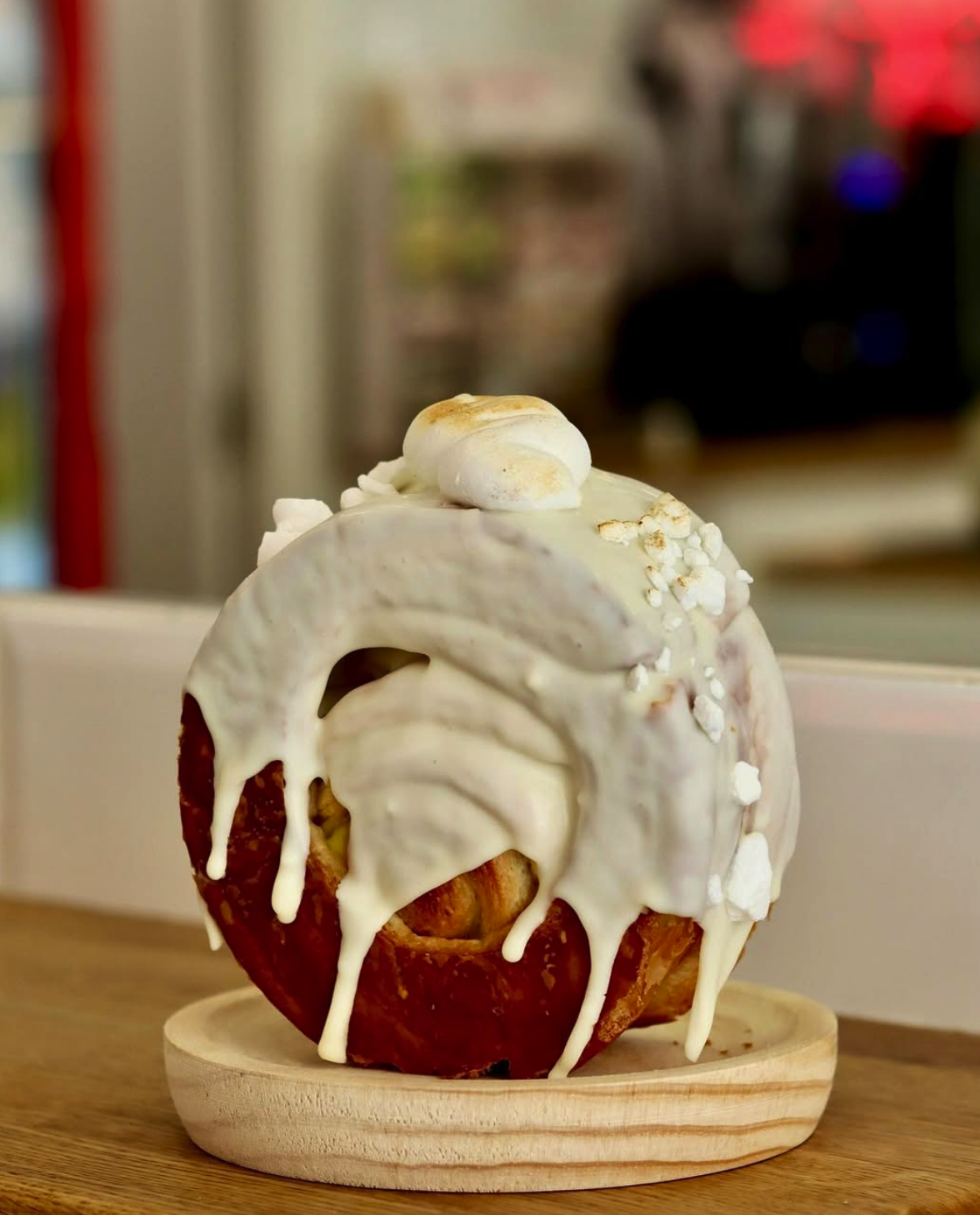
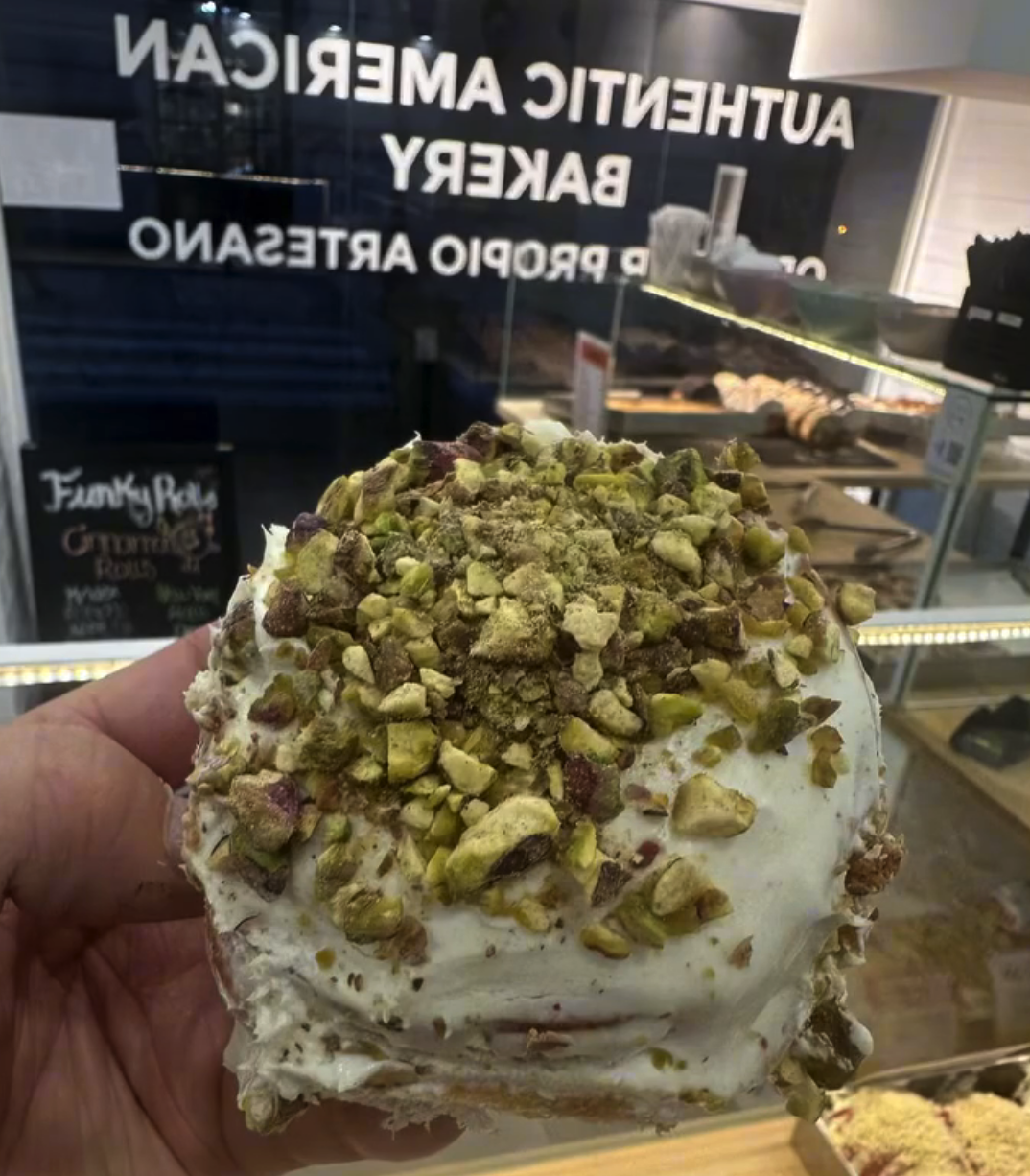
Inside was a cinnamon roll bakery.
This was, I should add, just after a seven-day cruise, which meant we had already spent a week passing cinnamon rolls at breakfast buffets and making all the usual promises to ourselves about getting back to normal. But a promising cinnamon roll shop in Zaragoza is not the moment for restraint. It is the moment for research.
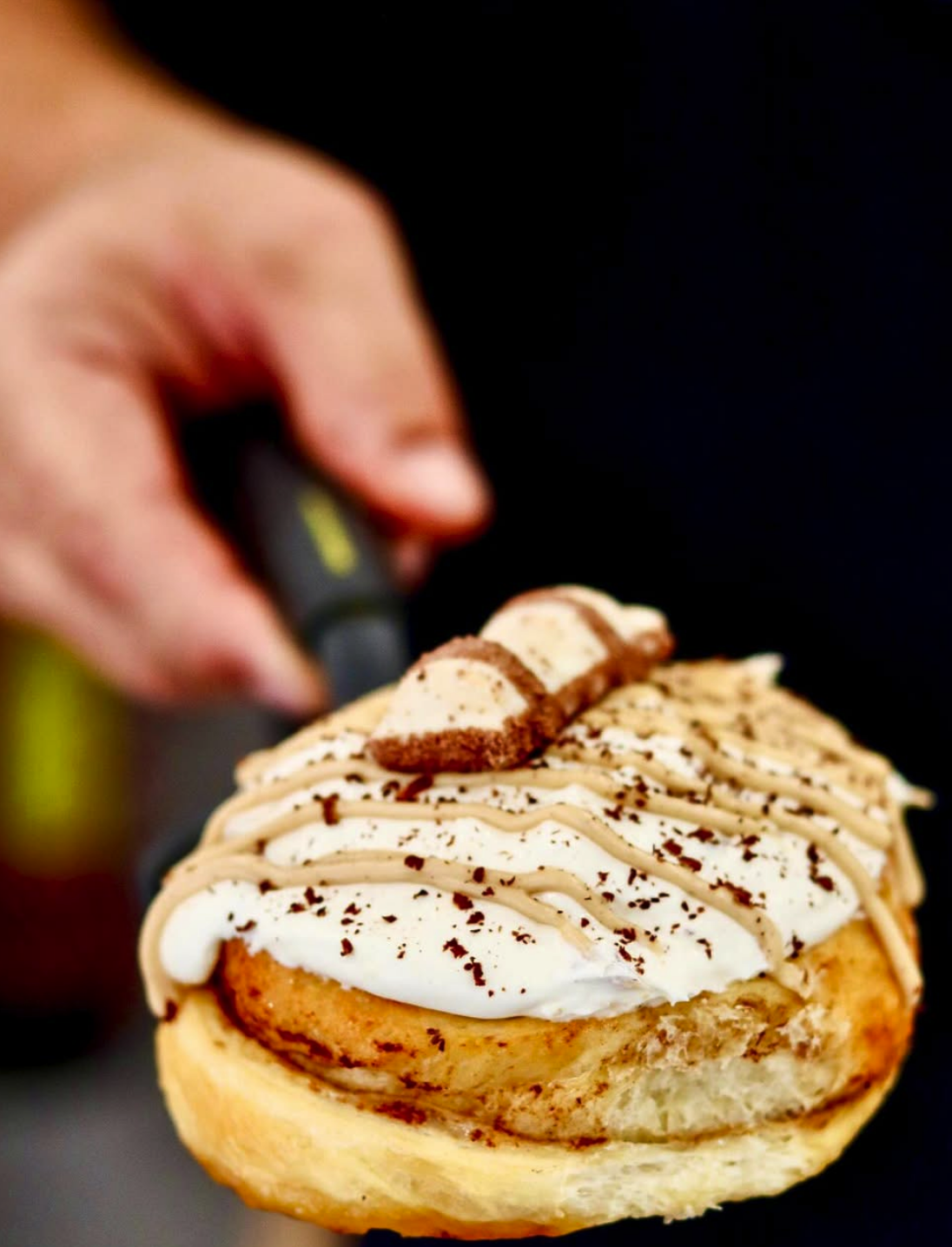
We chose pistachio, because I live in Sicily and some loyalties are not negotiable. We also chose the classic, because that is the real test. For the record, my sister’s cinnamon rolls at ColJack in Farmington, Missouri, remain the family control group.
The rolls came with us to the gastronomic society, which turned out to be lucky because Guillermo had forgotten the apples for the apple strudel.
The cinnamon rolls became dessert.
My father, who considers himself something of a cinnamon roll authority, gave them a 9.5 out of 10. The missing half point was reserved, naturally, for his other daughter’s rolls. My Spanish in-laws went back for seconds.
That is how Funky Rolls entered the ViaMonde conversation: not as an abstract investment opportunity, but as something we had smelled, carried, sliced, shared, and watched disappear from a table.
Only later did the business side become interesting.
Funky Rolls, an established bakery in the historic center of Zaragoza, is available for acquisition. It sits just steps from the cathedral, in one of the city’s most visible pedestrian corridors, with an equipped storefront, developed recipes, supplier relationships, operating systems, licenses, and a brand already in motion.
The current owner is relocating to the United States for family reasons, creating an opening for the right buyer to step into what has already been built and decide what comes next.
This is not an empty storefront or a romantic idea waiting to be tested. It is a small, operating business with proof of life.
And that matters.
Spain has already shown an appetite for well-branded, experience-driven food concepts, especially when the product is clear and the execution is consistent. Barcelona has Sil’s Cakes, an American pastry shop, and Demasié, a Barcelona-born bakery known for cookies and cinnamon rolls. Madrid has American-style bakery concepts such as TastyCakes and The Cookie Lab. Add in the broader Spanish growth of burgers, BBQ, healthy fast casual, specialty coffee, and modern grab-and-go food, and the pattern becomes easier to see.
Spain is not allergic to these concepts. A cinnamon roll, a cookie, a barbecue plate, a burger, a salad bowl, a coffee counter, a sandwich line: when the idea is simple enough to understand and good enough to become part of someone’s routine, there is room to build around it.
Funky Rolls already has the bakery foundation. The sandwich line has also been developed, which changes the shape of the opportunity. A sweet shop is one kind of business. A compact bakery, coffee, and sandwich concept in a highly visible location is something broader. It can serve the morning crowd, the lunch crowd, the visitor, the office worker, the student, the person who wants a treat, and the person who needs something practical.
That is when a small shop starts to look less like a job and more like a platform.
For the right buyer, Funky Rolls could become a Zaragoza flagship. Not because scale is guaranteed, but because the bones are there: location, product, systems, licenses, brand identity, and a concept that can be made stronger by an owner who understands hospitality, consistency, and local rhythm.
That is the part I understand personally.
I have been an entrepreneur my entire adult life. I know the difference between buying yourself endless stress and building something that gives your life a center. A good business is not only about what it earns. It is about the life that forms around it: the routine, the relationships, the responsibility, and the slow process of becoming part of a place.
For someone relocating to Spain, that can be powerful.
A lease gives you an address. A business can give you a role.
It puts you in conversation with suppliers, neighbors, employees, customers, accountants, landlords, city offices, delivery drivers, and the person who comes in every Thursday and orders the same thing. It gives your family a reason to be known locally. It gives the move a structure that is not dependent on novelty.
That does not make it easy. It makes it real.
Funky Rolls currently reports active-season monthly revenue of approximately €12,000 to €14,000, with monthly rent of €1,300. The asking price is €85,000 to €95,000, negotiable. The space is approximately 45m², which makes it more manageable for an owner-operator, couple, or entrepreneurial family than a larger hospitality operation with heavy staffing demands.
The business is being offered as a traspaso, or transfer of an existing business activity. The opportunity includes equipment, recipes, standard operating procedures, supplier contacts, brand assets, licenses, and the developed sandwich line.
Of course, this kind of acquisition has to be reviewed carefully. Buying a business is not automatically a visa. The lease, licenses, financials, company structure, tax position, business plan, immigration strategy, housing plan, and family relocation timeline all need to be assessed together.
That is where this becomes ViaMonde work.
Our Spanish attorney and relocation team can assist with the legal review, acquisition structure, visa strategy, housing search, and the practical transition into life in Spain.
For some families, Spain will not begin with a retirement plan or a remote job.
It may begin with a small storefront in Zaragoza, ovens warming before the city is fully awake, and a business that gives the family something real to build.
For the right person, that may be the most interesting relocation plan of all.